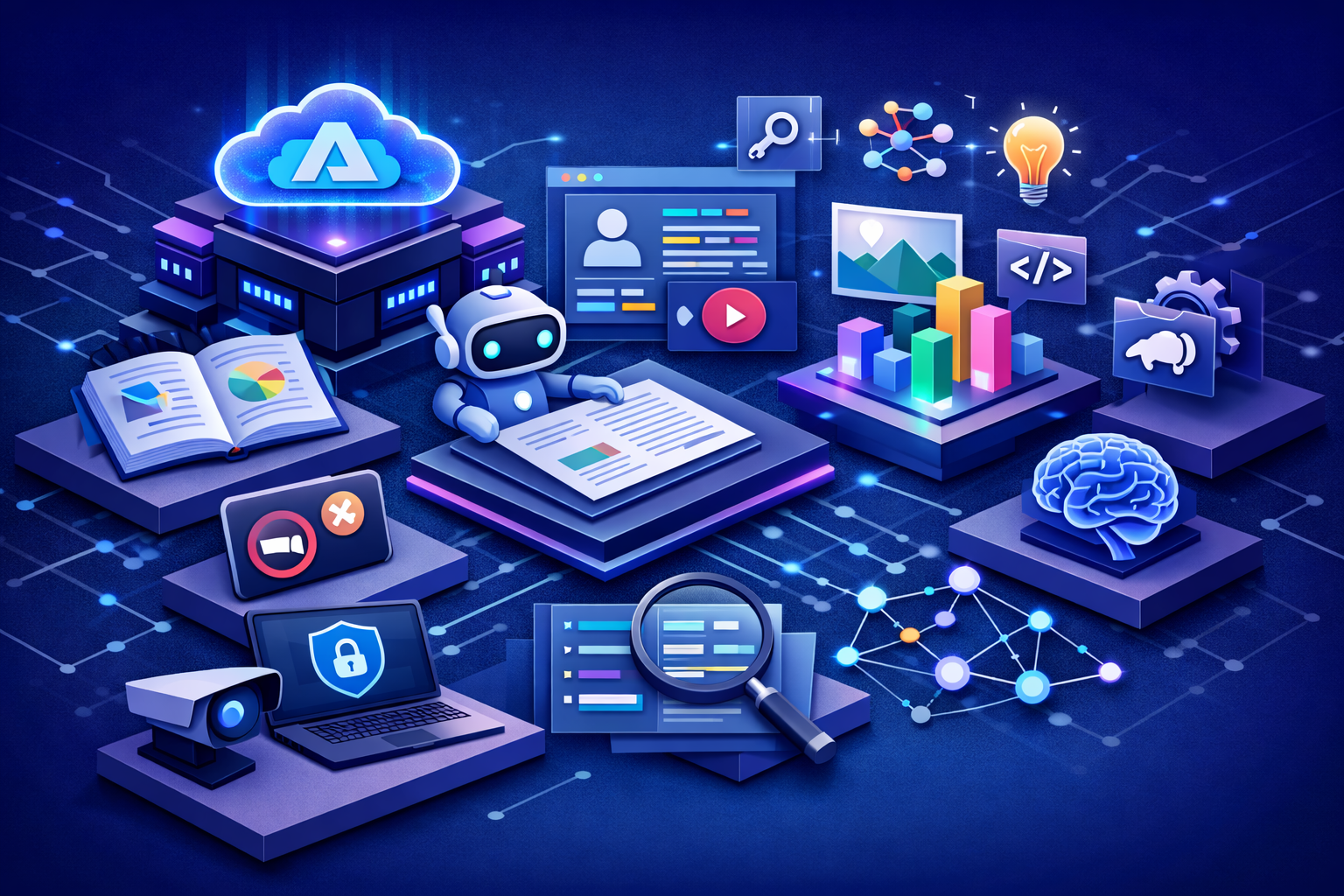
Understanding Azure AI Content Understanding
Azure AI Content Understanding is a Microsoft Azure AI capability designed to help organizations analyze and structure complex content across multiple modalities, including documents, images, audio, and video. Instead of treating each content type as a separate problem, it provides a more unified approach for extracting meaning, organizing outputs, and preparing information for automation, analytics, retrieval, and intelligent application workflows.
This is especially valuable in enterprise environments where important information is often buried inside contracts, scanned files, recorded calls, video assets, forms, reports, multimedia evidence, and other content that is difficult to process manually at scale. Azure AI Content Understanding helps convert that complexity into structured outputs that applications, workflows, and AI systems can use more effectively.
Why Content Understanding Matters in Modern Organizations
Many organizations already have large volumes of content, but the real challenge is making that content useful. Unstructured and multimodal data often contains critical business knowledge, yet it can be difficult to search, classify, summarize, or connect to operational systems without substantial manual effort. This creates delays, inconsistency, and missed opportunities for automation.
Azure AI Content Understanding matters because it helps organizations bridge the gap between raw content and operational intelligence. Rather than extracting only text or relying on isolated point solutions, it supports a broader understanding of content structure, meaning, and business relevance. That makes it easier to build workflows that are more scalable, reliable, and aligned with enterprise needs.
Core Capabilities of Azure AI Content Understanding
Azure AI Content Understanding includes several important capabilities that make it well suited for modern multimodal and document-heavy environments.
-Multimodal Content Analysis: Processes documents, images, audio, and video through a unified service model that supports richer understanding across different content types.
-Schema-Driven Extraction: Allows organizations to define the fields, classifications, and outputs they want, making structured extraction easier and more consistent.
-Classification and Segmentation: Helps identify content types and split complex inputs into meaningful sections or categorized outputs for downstream workflows.
-Confidence Scores and Grounding: Supports more trustworthy processing by providing confidence signals and grounding information that can reduce unnecessary manual review.
-Prebuilt and Industry-Oriented Analyzers: Supports common business scenarios through analyzer patterns that accelerate adoption for document-rich processes.
-Structured and Searchable Output: Converts difficult content into organized data that can support search, analytics, retrieval, and AI-driven applications.
-Automation Readiness: Produces outputs that are easier to integrate into business workflows, downstream systems, and intelligent decision-support processes.
From Raw Files to Structured Business Value
The true strength of Azure AI Content Understanding lies in how it changes the role of content inside the enterprise. A document is no longer just a file. A video is no longer only media. An audio recording is no longer just a conversation archive. With the right analyzer and schema, these content types become sources of structured knowledge that can be searched, classified, summarized, validated, and routed into operational systems.
This makes content understanding especially useful for organizations that want to reduce manual review, improve speed, and support more advanced AI solutions. It shifts content processing from passive storage to active business enablement.
Schema-Driven Extraction and Why It Matters
One of the most practical advantages of Azure AI Content Understanding is its schema-driven model. Instead of relying on broad prompts or inconsistent extraction logic, organizations can define the fields, structure, and outputs they want from a given content type. This improves consistency and makes it easier to align the service with real business processes.
In enterprise settings, this matters because workflows often depend on predictable outputs. Teams may need to extract contract terms, procurement details, tax-related fields, call summaries, media insights, or categorized document types. A schema-driven approach helps produce outputs that are more suitable for automation, auditability, and downstream system integration.
Classification and Segmentation Across Complex Content
Enterprise content is rarely clean or uniform. A single file may contain multiple documents, mixed formats, long sections, or content that must be categorized before it can be processed properly. Azure AI Content Understanding supports classification and segmentation to help address this complexity.
This capability is especially useful in scenarios where organizations receive large batches of varied documents, long contracts, mixed tax files, multi-part procurement content, or video assets that need to be divided into meaningful segments. By identifying content types and splitting inputs into manageable parts, the service helps organizations build workflows that are both smarter and more efficient.
Key Business Use Cases
Intelligent Document Processing
Organizations can use Azure AI Content Understanding to process complex business documents more effectively by extracting structured fields, classifying document types, and reducing the manual review required to handle large document volumes. This is highly relevant for finance, procurement, legal operations, claims, compliance, and administrative workflows.
Audio and Call Content Analysis
Audio-based content such as customer calls, interviews, support recordings, and operational voice notes often contains valuable insights that are difficult to use without structure. Azure AI Content Understanding can help convert spoken content into organized outputs that are easier to review, search, and integrate into service or analytics workflows.
Video and Media Understanding
Video content can be rich in operational and contextual information, but extracting that information manually is time-consuming. Azure AI Content Understanding helps organizations process video content more intelligently by identifying structure, summarizing useful information, and supporting workflows that depend on better visibility into media assets.
Retrieval-Augmented Generation and AI Grounding
Modern AI applications often need clean, structured, and grounded content before generative models can produce reliable responses. Azure AI Content Understanding helps prepare complex content for retrieval and downstream reasoning by turning multimodal inputs into more predictable and AI-friendly outputs. This makes it especially relevant for knowledge assistants, enterprise copilots, and intelligent agents.
Industry-Specific Content Workflows
Different industries face different content challenges. Procurement teams need structured vendor and contract information. Tax-related operations require document categorization and field extraction. Media and communications teams need insight from audio and video assets. Azure AI Content Understanding supports these broader operational scenarios by offering a more flexible way to process diverse content types within a single framework.
How Azure AI Content Understanding Fits into the Azure AI Ecosystem
Azure AI Content Understanding becomes more powerful when used as part of a broader Azure architecture. In many enterprise environments, it acts as the content interpretation layer that prepares information for search, AI reasoning, automation, and analytics.
-Azure AI Search: Uses structured content outputs to improve retrieval, indexing, and grounded enterprise search experiences.
-Azure OpenAI Service: Benefits from cleaner and more structured context when generating grounded responses across business content.
-Azure AI Foundry: Provides the broader platform for organizing, evaluating, and governing intelligent applications that depend on multimodal content processing.
-Azure AI Agent Service: Allows agents to work with more reliable inputs derived from complex content, improving automation and decision support.
-Azure AI Document Intelligence: Complements content understanding in document-centric architectures where document extraction and multimodal understanding need to work together.
-Azure Storage, Data Platforms, and Workflow Services: Support ingestion, storage, orchestration, and downstream integration for production-grade solutions.
-Azure Monitor, Key Vault, and Microsoft Entra: Strengthen observability, security, access control, and secrets management across the solution lifecycle.
Architecture Considerations for Production Deployments
A production-ready content understanding solution should be designed with ingestion patterns, schema design, classification needs, content variability, validation requirements, and downstream integration in mind. The service is most effective when its outputs are treated as part of a broader workflow rather than as an isolated extraction step.
In many enterprise architectures, source content is stored in Azure repositories, processed through Content Understanding analyzers, validated through business logic, and then routed to search indexes, AI applications, dashboards, or transactional systems. This architecture helps ensure that extracted meaning is not only technically accurate, but also operationally useful.
Confidence, Grounding, and Operational Trust
Trust is an essential part of any AI-driven content workflow. Azure AI Content Understanding supports this through confidence scores and grounding-related outputs that help teams understand how strongly the system supports a given result. These signals are important because they make it easier to decide when automation is appropriate and when human review should still be involved.
In real enterprise processes, not all outputs carry the same business risk. Some can move directly into workflow automation, while others may need review because of legal, financial, or compliance implications. Confidence-based design helps organizations strike the right balance between efficiency and control.
Best Practices for Azure AI Content Understanding Adoption
-Start with a High-Value Content Problem: Focus on workflows where complex content creates measurable delays, costs, or operational friction.
-Define a Clear Schema Early: Identify the fields, categories, and outputs the business truly needs before scaling the solution.
-Use Classification Strategically: Apply categorization and segmentation when content arrives in mixed formats or needs different processing paths.
-Design for Validation: Use confidence signals and review logic to support reliable automation in sensitive business scenarios.
-Integrate with Search and AI Architectures: Treat content understanding as part of a larger knowledge and automation strategy.
-Monitor and Refine Continuously: Evaluate output quality, workflow fit, and business impact as content patterns and requirements evolve.
Common Challenges Organizations Should Address
Although Azure AI Content Understanding simplifies many content-processing tasks, organizations should still prepare for practical challenges such as inconsistent source quality, mixed content types, ambiguous structures, evolving schema requirements, and the complexity of connecting structured outputs to business systems. These are common realities in enterprise content environments.
Another challenge is assuming that extracting information is the same as making it useful. Real transformation happens when structured outputs are integrated into search, analytics, automation, and decision-support systems. The strongest implementations therefore focus not only on extraction quality, but on operational adoption and workflow design.
The Strategic Value of Content Understanding
Azure AI Content Understanding delivers strategic value by helping organizations make sense of content that was previously difficult to use at scale. It turns complex files and media into assets that can support faster decisions, smarter automation, stronger knowledge access, and more reliable AI-driven systems. In content-heavy enterprises, this can reduce operational overhead while improving the quality and speed of information-driven work.
More broadly, content understanding helps organizations move toward a more intelligent operating model. Instead of leaving important knowledge trapped in documents, media, and unstructured sources, they can convert it into business-ready information that supports digital transformation more directly.
The Future of Multimodal Content Processing in Azure
The future of enterprise AI will depend increasingly on how well organizations can work with multimodal content. Intelligent applications, agents, and copilots need cleaner, more structured, and more grounded inputs if they are to deliver reliable business value. Azure AI Content Understanding is well positioned for this future because it is designed to handle complexity across multiple content types within a more unified framework.
As organizations continue building more advanced retrieval systems, agentic workflows, and AI-driven automation, content understanding will become an even more important layer in the enterprise architecture. Making complex content easier to use is not only a technical improvement. It is a strategic advantage.
Conclusion
Azure AI Content Understanding is making complex content easier to use by helping organizations transform documents, images, audio, and video into structured, searchable, and workflow-ready outputs. With schema-driven extraction, multimodal analysis, classification, segmentation, and confidence-based processing, it provides a strong foundation for intelligent content workflows across the Azure ecosystem. For organizations looking to reduce manual effort, improve knowledge access, and build more capable AI-driven systems, Azure AI Content Understanding represents a powerful step forward.