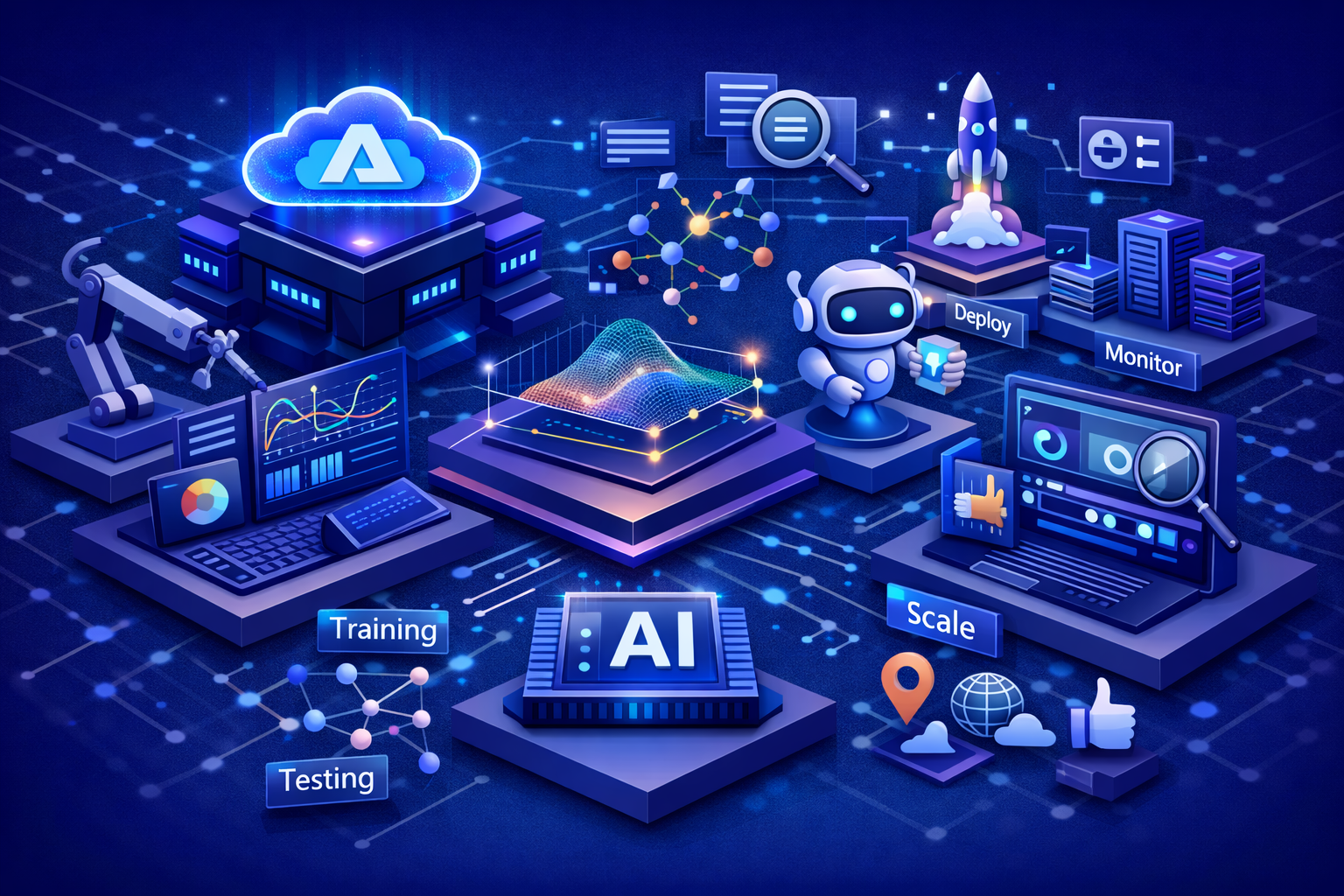
Understanding Azure Machine Learning
Azure Machine Learning is a cloud-based service designed to accelerate and manage the machine learning project lifecycle. It helps data scientists, machine learning engineers, and platform teams develop models, track experiments, prepare data workflows, manage assets, deploy endpoints, and operate machine learning solutions in production. Instead of treating model building as a one-time technical exercise, Azure Machine Learning supports a more complete operating model where experimentation, deployment, governance, and monitoring are all part of the same platform.
This matters because enterprise machine learning is rarely just about training a model. Organizations must also handle collaboration, repeatability, security, model versioning, deployment automation, monitoring, and lifecycle governance. Azure Machine Learning addresses these needs by providing a managed environment that works across classical machine learning, deep learning, and broader AI solution development.
Why Azure Machine Learning Matters
Many organizations can build a model prototype, but far fewer can operate machine learning consistently at scale. The difficulty usually appears after experimentation, when teams need to move from notebooks and isolated training jobs into repeatable pipelines, managed endpoints, auditable processes, and secure production operations. Azure Machine Learning matters because it helps bridge that gap.
It provides a structured platform for turning machine learning into an enterprise capability rather than a collection of disconnected experiments. This is especially important for organizations that need to balance innovation with governance, cost control, operational reliability, and business impact. By supporting the full lifecycle, Azure Machine Learning helps teams move from model development to production in a more disciplined and scalable way.
Core Capabilities of Azure Machine Learning
Azure Machine Learning includes a broad set of capabilities that support model development, training, deployment, and lifecycle management across enterprise scenarios.
-Workspaces and Asset Management: Organizes projects, models, environments, data references, components, and other machine learning assets in a collaborative Azure environment.
-Model Development and Experimentation: Supports notebooks, SDK-based workflows, experiment tracking, and open-source frameworks such as PyTorch, TensorFlow, scikit-learn, XGBoost, and LightGBM.
-Automated Machine Learning: Helps teams automate repetitive model development tasks such as feature engineering, algorithm selection, and hyperparameter optimization.
-Designer and Low-Code Options: Provides visual tools for building pipelines and model workflows without requiring entirely code-first development.
-Managed Compute: Offers scalable CPU and GPU resources, compute instances, compute clusters, serverless options, and distributed training support.
-Model Deployment: Supports managed online endpoints for real-time inference and batch endpoints for asynchronous and large-scale scoring scenarios.
-MLOps and Lifecycle Operations: Enables model versioning, monitoring, retraining, redeployment, and governance across production machine learning systems.
From Experimentation to Production-Ready ML
One of the main strengths of Azure Machine Learning is that it supports the transition from research-oriented model development to production-ready machine learning operations. In many organizations, data science teams can build useful experiments, but the challenge is making those experiments reproducible, supportable, and deployable across environments. Azure Machine Learning helps address this by providing shared assets, controlled compute, deployment targets, and operational tooling that fit into enterprise delivery practices.
This allows teams to think beyond isolated notebooks and toward a repeatable lifecycle. Data can be prepared through pipelines, models can be versioned and registered, endpoints can be deployed in a controlled way, and production behavior can be observed over time. That shift is essential for organizations that want machine learning to become part of business-critical systems rather than remaining limited to experimentation.
Key Components of Azure Machine Learning
Azure Machine Learning includes several important platform components that work together across the machine learning lifecycle.
-Workspace: The central resource for collaboration, asset management, access control, and project organization.
-Compute Instances: Managed development environments for interactive model development, notebooks, and experimentation.
-Compute Clusters: Scalable training infrastructure for running jobs on demand, including GPU-enabled workloads and distributed training.
-Jobs and Components: Modular building blocks for running training, preprocessing, evaluation, and other tasks in repeatable pipelines.
-Model Registry: A central place to store and manage model versions and related metadata.
-Online Endpoints: Deployment targets for real-time inferencing in production applications.
-Batch Endpoints: Deployment options for long-running, asynchronous, or large-volume prediction workloads.
-Monitoring and MLOps Tooling: Features that support observability, drift detection, retraining workflows, and operational governance.
Open and Interoperable Machine Learning
A major advantage of Azure Machine Learning is its support for open-source machine learning tools and frameworks. Organizations are not locked into a single proprietary modeling approach. Teams can use familiar libraries such as PyTorch, TensorFlow, scikit-learn, and other Python-based tools while benefiting from Azure’s managed infrastructure, deployment options, and lifecycle controls.
This interoperability is important because enterprise machine learning environments are rarely homogeneous. Different teams may use different frameworks, training patterns, or deployment methods depending on the use case. Azure Machine Learning provides a platform layer that supports this diversity while still giving the organization a more standardized operational model.
Automated Machine Learning and Productivity at Scale
Automated Machine Learning, often referred to as AutoML, is one of the most practical features of Azure Machine Learning for accelerating model development. It helps data scientists, analysts, and developers reduce time spent on repetitive tasks such as trying multiple algorithms, tuning hyperparameters, and evaluating candidate models. This can significantly improve productivity, especially in classical machine learning use cases where model comparison and feature handling consume considerable effort.
AutoML does not eliminate the need for expert judgment, but it allows teams to move faster and explore more options systematically. For organizations trying to scale model development across many business problems, that efficiency can be highly valuable.
Deployment Options for Real-Time and Batch Inference
Azure Machine Learning supports more than one production inference pattern, which is important because not all business scenarios need the same deployment model. Some applications require low-latency, real-time predictions that can respond instantly to user or system input. Others need large-scale asynchronous scoring over datasets, files, or scheduled processing windows. Azure Machine Learning addresses both patterns through managed online endpoints and batch endpoints.
This flexibility allows organizations to align deployment design with business need. Real-time fraud scoring, recommendation APIs, and operational risk checks may require online endpoints. Periodic forecasting, document enrichment, customer segmentation, and large-scale analytics pipelines may be better suited to batch processing. Having both options within one platform improves consistency and reduces architectural fragmentation.
MLOps and Enterprise Model Lifecycle Management
Machine learning in production requires more than deployment. Models change, data drifts, requirements evolve, and business expectations increase over time. Azure Machine Learning supports MLOps practices that help teams manage the lifecycle of models in a structured and auditable way. This includes model registration, versioning, deployment workflows, monitoring, retraining patterns, and integration with broader DevOps processes.
MLOps is especially important because machine learning systems are dynamic by nature. A model that performs well today may degrade as data patterns change. Azure Machine Learning helps organizations address this reality by making it easier to monitor, maintain, and update models rather than treating deployment as the end of the project.
Key Business Use Cases
Predictive Analytics and Forecasting
Organizations can use Azure Machine Learning to build models that support forecasting, risk scoring, demand planning, churn prediction, and other predictive business scenarios. These models can help improve decisions across finance, retail, logistics, manufacturing, and customer operations.
Computer Vision and Deep Learning Workloads
Azure Machine Learning supports deep learning workflows that require GPU-based training, distributed compute, and flexible framework support. This makes it useful for organizations building advanced vision models, image classification solutions, and custom AI workloads that go beyond low-code services.
Operational Machine Learning in Business Applications
Many organizations need models that can run inside applications, decision systems, and automated workflows. Azure Machine Learning supports this by providing managed deployment options and lifecycle controls that help models operate reliably in production environments.
Data Science Collaboration and Platform Standardization
Enterprises often struggle when machine learning efforts are spread across fragmented tools and ad hoc environments. Azure Machine Learning helps centralize development, assets, and deployment processes, creating a more consistent environment for collaboration between data scientists, engineers, and platform teams.
Generative AI and Model Catalog Workflows
Azure Machine Learning also plays a role in broader AI application development through tools such as model catalog access and prompt-oriented workflows. This gives organizations a way to work across both traditional machine learning and newer AI solution patterns within related Azure ecosystems.
How Azure Machine Learning Fits into the Azure AI Ecosystem
Azure Machine Learning is most powerful when used as part of a broader Azure architecture. In many enterprise solutions, it acts as the machine learning development and operations platform while other Azure services provide complementary capabilities around data, search, applications, security, and AI interaction.
-Azure AI Foundry: Supports broader intelligent application and AI solution development across models, tools, and agent-driven experiences.
-Azure OpenAI Service: Complements Azure Machine Learning in generative AI scenarios where advanced language or multimodal capabilities are required.
-Azure AI Search: Works with model-driven and generative AI applications that depend on grounded retrieval and enterprise knowledge access.
-Microsoft Fabric, Azure Databricks, and Data Platforms: Help prepare, process, govern, and operationalize the data used in machine learning workflows.
-Azure Kubernetes Service and Managed Endpoints: Support production deployment patterns and scalable inference architectures.
-Azure Monitor, Application Insights, Key Vault, and Microsoft Entra: Strengthen observability, security, secrets management, and identity control across the solution lifecycle.
Architecture Considerations for Production-Scale ML
A production-ready Azure Machine Learning implementation requires more than selecting an algorithm. Teams should think carefully about data pipelines, environment reproducibility, compute sizing, experiment tracking, model governance, deployment strategy, endpoint design, monitoring, and retraining triggers. These choices affect not only model performance, but also operational stability and long-term maintainability.
In many enterprise architectures, data is ingested and prepared in Azure data services, models are trained and tracked in Azure Machine Learning, validated through pipeline-based workflows, deployed to managed endpoints, and observed through operational monitoring. This end-to-end view is essential for organizations that want machine learning systems to support real business processes at scale.
Security, Governance, and Responsible AI
Machine learning solutions often involve sensitive data, high-impact decisions, or regulated business processes. For that reason, Azure Machine Learning should be implemented as part of a secure and governed architecture. Access controls, managed identities, secrets protection, auditability, policy alignment, and environment standardization all play an important role in making model operations trustworthy.
Responsible AI is equally important. Models must be evaluated not only for accuracy, but also for fairness, explainability, reliability, and appropriate use. Organizations should define validation practices, review processes, and monitoring strategies that match the business impact of each model. Azure Machine Learning provides the operational foundation, but trustworthy AI still depends on strong governance and informed human oversight.
Best Practices for Azure Machine Learning Adoption
-Start with a Clear Business Problem: Focus on use cases where machine learning can create measurable impact rather than building models without an operational goal.
-Standardize Assets and Environments: Use shared workspaces, versioned assets, and repeatable components to improve consistency across teams.
-Choose the Right Compute Strategy: Match compute instances, clusters, GPUs, and serverless resources to the workload rather than overengineering infrastructure.
-Design for MLOps Early: Plan for versioning, deployment, monitoring, retraining, and governance from the beginning of the project.
-Use the Right Inference Pattern: Select online endpoints for real-time scenarios and batch endpoints for large-scale asynchronous scoring.
-Monitor Continuously: Track model quality, drift, latency, resource usage, and business impact after deployment instead of stopping at launch.
Common Challenges Organizations Should Address
Although Azure Machine Learning provides a strong platform foundation, successful implementation still requires careful planning. Common challenges include poor data quality, inconsistent experimentation practices, weak deployment discipline, unclear ownership between data science and engineering teams, inadequate monitoring, and unrealistic assumptions about how quickly prototypes can become production systems.
Another common challenge is underestimating the importance of operational maturity. The model itself is only one part of the solution. Business value depends on whether the surrounding architecture, governance, and workflows are strong enough to support the model over time. The organizations that succeed with Azure Machine Learning are usually the ones that treat machine learning as an operational capability, not only as a technical experiment.
The Strategic Value of Azure Machine Learning
Azure Machine Learning delivers strategic value because it helps organizations industrialize machine learning. It supports the shift from isolated experimentation to platform-based delivery, where models can be developed, deployed, managed, and improved systematically. This helps reduce friction between innovation and production operations, which is one of the most common barriers to enterprise AI success.
For business leaders, this means machine learning can become more than a specialized technical initiative. It can become a scalable capability that supports forecasting, optimization, automation, personalization, risk management, and operational intelligence across the organization.
The Future of Machine Learning Operations on Azure
The future of Azure Machine Learning is closely tied to the continued convergence of data science, AI engineering, MLOps, and intelligent application development. As organizations increasingly combine traditional machine learning with generative AI, retrieval, orchestration, and responsible AI controls, the need for strong lifecycle management will become even more important.
Azure Machine Learning is well positioned for this future because it already supports both foundational machine learning operations and broader AI development workflows. As production AI systems continue to grow in complexity, platforms that can manage development, deployment, and governance in a unified way will become even more valuable.
Conclusion
Azure Machine Learning provides a comprehensive foundation for taking machine learning from model development to production at scale. With support for experimentation, AutoML, managed compute, open-source frameworks, real-time and batch deployment, and full MLOps practices, it enables organizations to operationalize machine learning with greater consistency and control. For enterprises looking to build secure, scalable, and production-ready ML solutions on Microsoft Azure, Azure Machine Learning remains one of the most important platforms in the modern AI landscape.