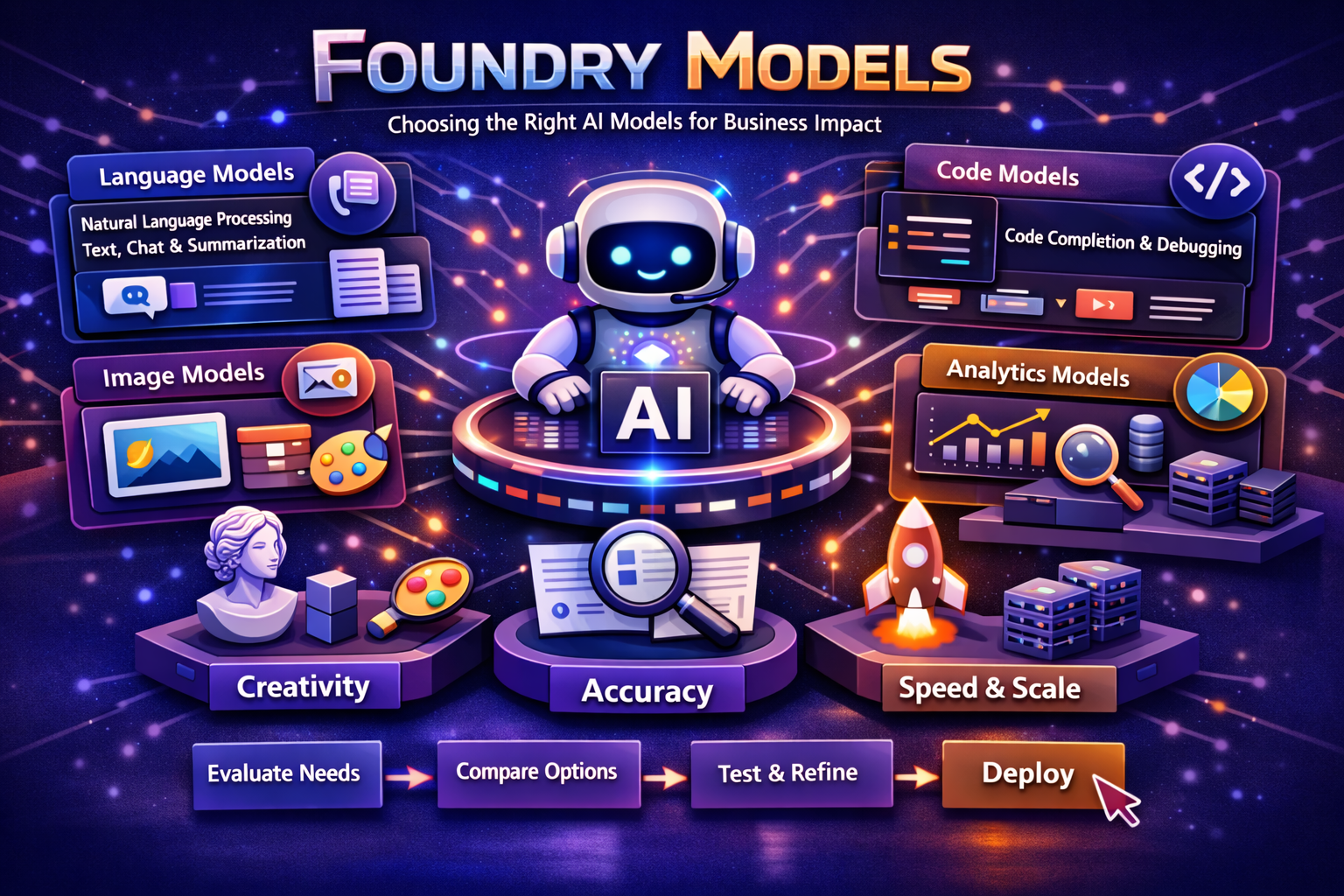
Understanding Foundry Models
Microsoft Foundry Models is the model catalog and model access layer within Microsoft Foundry. It is designed to help organizations discover, compare, evaluate, customize, and deploy AI models in a more structured and enterprise-ready way. Instead of forcing teams to search across disconnected providers and tooling, Foundry Models brings a wide range of models into one environment where they can be assessed and used with greater consistency.
This matters because the AI landscape is growing quickly. Different models are optimized for different tasks, cost profiles, response times, safety requirements, and business use cases. Some are strong at reasoning, some at multimodal understanding, some at lightweight and cost-efficient inference, and others at domain-specific or industry-oriented scenarios. Foundry Models helps organizations navigate that complexity and choose more intentionally.
Why Model Choice Matters for Business Impact
Choosing an AI model is one of the most important decisions in any AI solution. The model affects not only what the application can do, but also how well it performs, how fast it responds, how expensive it becomes at scale, and how suitable it is for enterprise use. A model that performs brilliantly in one scenario may be inefficient, too costly, or overly complex in another.
Foundry Models matters because it helps organizations move away from model selection by hype and toward model selection by business fit. In enterprise environments, success depends on aligning model capabilities with real goals such as customer support, search, automation, code generation, content transformation, document understanding, multilingual interaction, or agent-based workflows. The right model should fit the problem, the architecture, and the operating constraints of the business.
The Breadth of the Foundry Model Catalog
One of the biggest strengths of Foundry Models is the breadth of the catalog. It gives organizations access to a large and diverse set of models from Microsoft and external providers, making it easier to explore different approaches within one platform experience. This helps teams compare options more effectively instead of becoming locked into a single model family too early.
-Foundation Models: Broad-purpose models that support text generation, reasoning, summarization, chat, and general AI tasks across many business scenarios.
-Reasoning Models: Models designed for more complex problem solving, multi-step thinking, and higher-value enterprise tasks where deeper reasoning matters.
-Small Language Models: More compact models that can be useful when latency, cost efficiency, or lightweight deployment is a priority.
-Multimodal Models: Models that can work across more than one type of input or output, such as text and images, enabling richer intelligent application design.
-Domain and Industry Models: Models oriented toward specific sectors or specialized tasks where generic models may not provide the best fit.
-Partner and Community Models: Additional model options from external providers that expand flexibility and support broader experimentation.
From Model Access to Model Strategy
Access to many models is valuable, but the real enterprise advantage comes from turning access into strategy. Foundry Models helps organizations think more clearly about why a model is being selected and how it supports business outcomes. This is important because model strategy should not be based only on raw benchmark enthusiasm. It should reflect business needs such as quality, explainability, speed, cost control, compliance, and deployment feasibility.
In practice, this means asking better questions. Does the use case require advanced reasoning or only fast text transformation? Does the solution need multimodal capability? Is a small model sufficient for the task? Does the business need hosted simplicity or more control over deployment? Foundry Models helps teams make these distinctions earlier and more systematically.
Model Categories and When They Matter
Reasoning and Complex Decision Support
Some enterprise scenarios require more than fluent text generation. They require a model that can follow longer chains of logic, work through more complex requests, and support analytical or decision-intensive tasks. In these cases, reasoning-oriented models can create stronger outcomes, especially for use cases such as advanced assistance, complex enterprise workflows, research support, and agent planning.
Speed and Cost Efficiency
Not every business scenario needs the most advanced or expensive model. Many applications benefit more from low latency, predictable throughput, and lower cost per request than from maximum reasoning depth. Small language models and more efficient general-purpose models can be a better fit for high-volume classification, summarization, chat support, and operational assistance.
Multimodal Experiences
As intelligent applications become more sophisticated, they often need to work across text, images, documents, and other content types. Multimodal models are useful in scenarios such as visual assistance, content interpretation, document-rich workflows, and AI systems that combine textual and visual understanding. Foundry Models makes it easier to evaluate these scenarios without leaving the broader platform environment.
Industry and Domain Alignment
Some business problems are highly specialized and benefit from models that are more aligned with a specific domain or industry context. This can be important in finance, healthcare, manufacturing, legal operations, and other sectors where language, compliance, and operational needs differ significantly from general consumer-oriented AI use cases.
Evaluating Models Before You Commit
One of the most important capabilities in Foundry Models is the ability to compare and evaluate models more systematically. Choosing the right model is rarely a matter of intuition alone. Teams need to assess how different models perform against realistic prompts, datasets, and business conditions. This is especially important when one model may perform better on quality while another is stronger on latency, throughput, or cost.
Foundry Models supports model comparison and evaluation so organizations can make more informed decisions before committing to production. This encourages a healthier AI development process in which teams validate assumptions, test trade-offs, and choose models based on evidence rather than marketing claims or early impressions.
Benchmarks, Trade-Offs, and Real-World Fit
Benchmarking is useful, but in enterprise AI it should always be interpreted in context. A model that ranks highly on a leaderboard may still be the wrong choice if it is too slow, too expensive, or poorly matched to the business domain. Foundry Models helps organizations compare trade-offs more directly so they can think in terms of fit rather than raw ranking.
This is where business impact becomes clearer. The best model is not always the most advanced model. It is the model that delivers the right balance of quality, cost, responsiveness, safety, and deployment suitability for the actual application. That balance is what determines whether the solution remains viable at enterprise scale.
Customization, Fine-Tuning, and Adaptation
Model selection is only part of the story. In many cases, organizations also need ways to adapt models to their own data, tone, workflows, or domain-specific expectations. Foundry Models supports this broader approach by fitting into an environment that includes model customization and fine-tuning options where supported.
This matters because enterprise AI rarely succeeds through generic model access alone. Businesses often need stronger alignment with internal knowledge, business terminology, structured outputs, and operational requirements. A good model strategy therefore considers not only which model to use, but also whether that model can be shaped effectively to support the organization’s real use case.
Deployment Paths and Operational Choice
Another important part of Foundry Models is deployment flexibility. Different models and providers support different deployment approaches, and those choices can affect latency, scalability, cost management, and operational control. Some organizations prefer the simplicity of fully hosted options, while others need more control or different infrastructure patterns depending on the workload.
This is important because enterprise AI is not only about experimentation. It is also about production architecture. Choosing the right model includes choosing a deployment model that aligns with usage patterns, service-level expectations, regional needs, and governance requirements. Foundry Models helps make that planning more practical by connecting model exploration to deployment reality.
How Foundry Models Fits into the Microsoft AI Ecosystem
Foundry Models becomes especially valuable when it is used as part of the broader Microsoft Foundry and Azure AI ecosystem. It serves as the model access and selection layer, while surrounding services provide orchestration, grounding, tools, observability, and enterprise controls.
-Microsoft Foundry: Provides the broader platform for building AI apps and agents with models, tools, observability, and trust features in one integrated environment.
-Azure OpenAI in Foundry Models: Gives organizations access to Azure OpenAI models within the broader model selection experience.
-Foundry Agent Service: Uses selected models as part of agentic workflows, reasoning patterns, and task-oriented AI architectures.
-Foundry Tools: Add capabilities such as language, speech, vision, translation, document intelligence, and content understanding to model-based solutions.
-Azure AI Search: Helps ground model responses in trusted enterprise content through retrieval-driven architectures.
-Observability and Evaluation Features: Support quality measurement, safety analysis, and operational visibility across deployed AI solutions.
Key Business Use Cases
Enterprise Copilots and Assistants
Organizations can use Foundry Models to identify the right models for internal copilots, employee assistance tools, customer support experiences, and knowledge-driven AI assistants. Different copilots may require different balances of reasoning, cost, and latency, which makes model choice especially important.
Retrieval-Augmented Applications
Applications that rely on enterprise grounding need models that work well with retrieved context and can generate reliable outputs from approved business content. Foundry Models helps teams compare options for these retrieval-based solution patterns.
Multimodal and Content-Rich Solutions
Businesses building solutions that involve text, images, documents, or mixed content can use Foundry Models to evaluate multimodal options that better match these richer scenarios. This is valuable in industries where content complexity affects both usability and business value.
Agentic Workflows and Automation
Agent-oriented systems often need models that can reason, follow instructions, call tools, and support multi-step actions more effectively. Foundry Models helps organizations choose models that are better aligned with these evolving intelligent workflow patterns.
Cost-Sensitive High-Volume AI
In many enterprise environments, AI is used at scale across large user populations or repeated transactions. In those situations, cost and throughput become as important as quality. Foundry Models helps teams compare model options that can support business scale more sustainably.
Best Practices for Choosing the Right Model
-Start with the Business Goal: Define the exact problem the model needs to solve before comparing options.
-Test More Than One Model: Avoid assuming that the first strong model is the best model for the workload.
-Evaluate Real Trade-Offs: Compare quality, safety, cost, throughput, and responsiveness in the context of the actual application.
-Use the Simplest Effective Model: Do not overselect a complex or expensive model when a smaller or faster model is sufficient.
-Plan for Production Early: Consider deployment, observability, governance, and scaling needs before the project moves too far.
-Revisit the Choice Over Time: Model strategy should evolve as the catalog grows and business requirements change.
Common Challenges Organizations Should Address
One of the most common mistakes in enterprise AI is assuming that model selection is a one-time or purely technical decision. In reality, it is deeply connected to business priorities, architecture, and operating economics. Common challenges include overvaluing benchmark popularity, underestimating cost, choosing models without realistic evaluation, and failing to consider long-term governance and production constraints.
Another challenge is moving too quickly from experimentation to standardization. A model that performs well in a small pilot may not remain the right choice at enterprise scale. Organizations should therefore treat model selection as an iterative discipline supported by evaluation, comparison, and operational feedback.
The Strategic Value of Foundry Models
Foundry Models delivers strategic value by helping organizations make AI model choice more intentional, more flexible, and more aligned with business outcomes. It reduces the friction of exploring a broad market of models and gives teams a more structured way to compare, evaluate, and deploy what fits best.
For enterprises, this means model selection becomes part of AI strategy rather than a guessing exercise. Better model decisions can improve user experience, reduce cost, strengthen safety, and make intelligent applications more sustainable over time. In a fast-moving AI landscape, that kind of disciplined selection is a real competitive advantage.
The Future of Enterprise Model Strategy
The future of enterprise AI will not be shaped by a single universal model. It will be shaped by model portfolios, evaluation discipline, deployment flexibility, and the ability to match models to specific business needs. As model catalogs continue to grow, organizations will need better ways to compare capabilities and make decisions with confidence.
Foundry Models is well positioned for that future because it gives enterprises a unified environment for model discovery, evaluation, and deployment across a broad and evolving ecosystem. As businesses scale AI across more applications, the ability to choose the right model for the right job will become one of the most important capabilities in the enterprise AI stack.
Conclusion
Foundry Models helps organizations choose the right AI models for business impact by bringing model discovery, comparison, evaluation, and deployment into a more structured Microsoft Azure experience. With access to a broad catalog that includes foundation, reasoning, multimodal, small language, and industry-focused models, it gives enterprises the flexibility to align AI capability with real business needs. For organizations building intelligent applications at scale, choosing the right model is not only about technical performance. It is about selecting the option that creates the strongest and most sustainable business value.