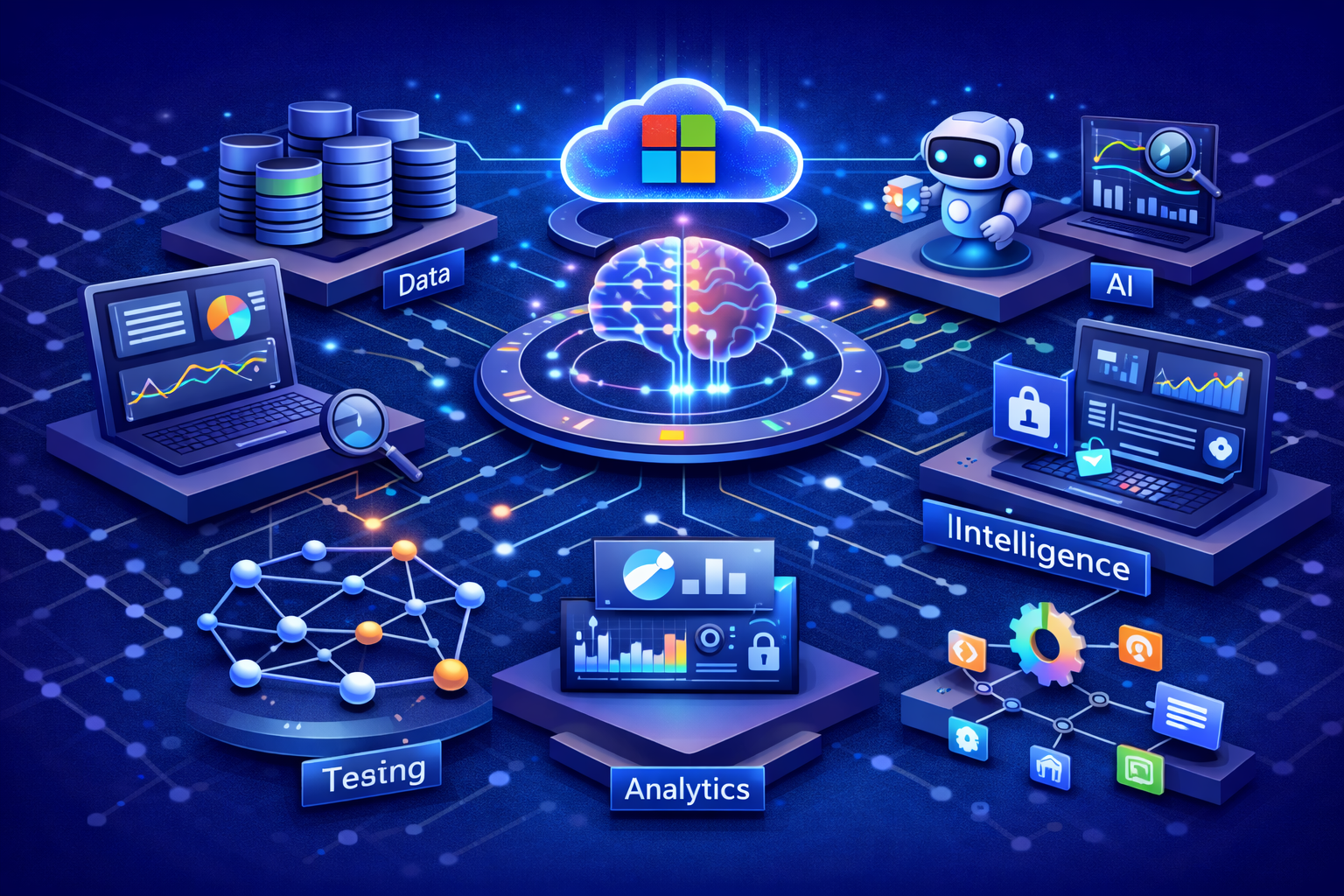
Understanding Microsoft Fabric for AI
Microsoft Fabric is an end-to-end analytics platform that unifies data movement, transformation, engineering, data science, real-time analytics, warehousing, databases, and reporting within a single software-as-a-service environment. When viewed through an AI lens, this matters because intelligent systems depend on much more than models alone. They require clean and governed data, scalable processing, real-time signals, collaboration across teams, and a controlled path from analysis to operational use.
Microsoft Fabric for AI is therefore not just about adding generative AI to reports or notebooks. It is about creating a connected environment where data can move more easily from ingestion to preparation, from analytics to machine learning, and from intelligence to business action. This unification makes AI adoption more practical, especially for organizations that want to reduce platform complexity while increasing the value of their data.
Why Fabric Matters for AI Initiatives
Many organizations struggle with AI not because they lack models, but because their data and analytics environments are fragmented. Data may live across warehouses, lakes, pipelines, dashboards, notebooks, operational systems, and external platforms that do not work together efficiently. This fragmentation slows experimentation, increases governance challenges, and makes it harder to operationalize AI across the business.
Microsoft Fabric matters because it offers a more unified path. By bringing multiple analytics experiences together on a shared platform and common storage model, it reduces the friction between data preparation, analytics, machine learning, business intelligence, and real-time processing. For AI initiatives, that means teams can move faster, collaborate more easily, and build intelligent solutions on top of a more coherent data foundation.
Core Capabilities That Make Fabric AI-Ready
Microsoft Fabric includes several capabilities that make it especially relevant for organizations building AI-driven solutions.
-OneLake: A unified logical data lake that acts as a common storage layer across Fabric workloads, reducing unnecessary duplication and making data easier to share and govern.
-Data Factory: Supports data ingestion, preparation, and transformation with a modern integration experience and a broad range of connectors.
-Data Engineering: Provides Spark-based processing for large-scale data preparation and engineering workflows.
-Data Science: Enables teams to build, deploy, and operationalize machine learning models from within Fabric, with integration to Azure Machine Learning for experiment tracking and model registry.
-Real-Time Intelligence: Helps organizations work with streaming data, event-driven scenarios, and fast-moving operational signals that can feed AI and decision systems.
-Data Warehouse and Databases: Support structured analytics, operational data scenarios, and scalable query workloads within the broader platform.
-Power BI: Connects analytics and business insight to decision-makers, making it easier to operationalize predictions and intelligence in reports and dashboards.
-Copilot and AI Features: Add generative AI assistance across Fabric workflows to accelerate development, analysis, and user interaction with data.
OneLake as the Foundation for Unified Intelligence
One of the most strategically important parts of Microsoft Fabric is OneLake. AI systems are only as effective as the data they can access, and many enterprises lose time and value because data is duplicated, siloed, or difficult to govern. OneLake helps address that challenge by providing a centralized logical data lake across Fabric workloads, allowing different teams and experiences to work from a shared foundation.
For AI initiatives, this means data engineering, analytics, machine learning, and reporting can operate more closely together. The result is not only lower complexity, but also a more direct path from data preparation to intelligence generation. In many organizations, that shared data foundation becomes one of the most important enablers of scalable AI.
Fabric Data Science and Machine Learning in Context
Microsoft Fabric includes a dedicated Data Science experience that allows organizations to build, deploy, and operationalize machine learning models from within the platform. This is important because AI work does not always need to begin in a separate specialized environment. In Fabric, data scientists can work closer to the data estate and collaborate more directly with analysts, engineers, and business teams.
Fabric Data Science also integrates with Azure Machine Learning for experiment tracking and model registry, which makes it easier to align collaborative analytics work with enterprise-grade ML operations. This combination helps organizations move more smoothly from descriptive insight toward predictive and machine learning-driven decision support.
Copilot and AI-Assisted Productivity Across Fabric
Microsoft Fabric includes Copilot capabilities that use large language models to help users interact with data and Fabric items more effectively. These AI-assisted experiences can support tasks such as generating code, authoring queries, building pipelines, summarizing results, and accelerating common analytics workflows. This matters because one of the biggest barriers to data-driven work is not only access to data, but the complexity of using it efficiently.
By embedding AI assistance into the platform, Fabric lowers the friction for different types of users, from developers and data professionals to self-service and business users. That does not replace expertise, but it can significantly improve productivity and make the platform more accessible to a broader range of teams.
AI Functions and Data Enrichment at Scale
Another important AI capability in Microsoft Fabric is AI Functions, which allow users to transform and enrich enterprise data with large language models using lightweight code patterns. These functions support scenarios such as summarization, classification, text generation, extraction, and multimodal file processing. This is especially valuable for organizations that want to bring AI directly into their data workflows rather than treating it as a separate application layer.
AI Functions also support scalable processing across Spark environments, which makes them relevant for larger enterprise datasets. In practical terms, this allows teams to use AI not only for chat experiences, but also for structured data enrichment, document processing, and business-ready transformation across analytics pipelines.
Real-Time Intelligence and AI on Data in Motion
AI becomes even more valuable when it can respond to fast-changing business conditions. Microsoft Fabric’s Real-Time Intelligence capability supports event-driven and streaming scenarios where organizations need to ingest, analyze, visualize, and act on data as it arrives. This is important for use cases such as operational monitoring, IoT analytics, clickstream analysis, and event-based automation.
When combined with AI, real-time data can support faster detection, smarter automation, and more responsive decision-making. This gives Fabric an advantage in scenarios where intelligence must operate not only on historical data, but also on live signals across the enterprise.
Emerging AI-Native Capabilities in Fabric
Microsoft Fabric is also evolving toward more AI-native platform capabilities. One example is Fabric IQ, which is currently in preview and is designed to unify business semantics across data, models, and systems. Its goal is to expose data to analytics, AI agents, and applications with more consistent meaning and context. This points to a broader direction in which Fabric is not only storing and analyzing data, but increasingly helping organizations organize that data according to business language and reusable semantics.
Another example is Fabric data agents, also in preview, which allow users to interact with their data more naturally through agent-like experiences powered by Azure OpenAI technologies. These developments suggest that Fabric is moving beyond being only an analytics platform and becoming a more active intelligence layer for data-driven applications.
How Fabric Fits into a Broader Microsoft AI Strategy
Microsoft Fabric becomes especially powerful when it is viewed as part of the broader Microsoft AI ecosystem. It provides the data and analytics foundation that can support intelligent applications, machine learning solutions, copilots, and agent-driven systems. In many organizations, Fabric is not the entire AI architecture, but it becomes the environment where enterprise data is prepared, governed, contextualized, and exposed to downstream AI capabilities.
-Azure Machine Learning: Extends Fabric’s data science workflows with enterprise-grade experiment tracking, model registry, and ML operational capabilities.
-Azure OpenAI Service: Supports generative AI applications that benefit from well-prepared, governed, and contextualized enterprise data.
-Azure AI Search: Helps connect enterprise retrieval scenarios with the data and knowledge managed across Fabric environments.
-Microsoft Purview: Provides built-in governance, permissions, sensitivity labels, and compliance capabilities across Fabric workloads.
-Power BI: Turns predictions, trends, and intelligence into decision-ready dashboards and business reporting experiences.
-Fabric Copilot, AI Functions, and Data Agents: Bring AI directly into analytics workflows, data transformation, and natural language interaction with enterprise data.
Key Business Use Cases
Unified AI-Ready Data Platforms
Organizations can use Microsoft Fabric to reduce fragmentation across data engineering, integration, science, and analytics teams. This makes it easier to create AI-ready environments where data is prepared once and used across multiple business and intelligence scenarios.
Predictive and Advanced Analytics
With Fabric Data Science and Azure Machine Learning integration, teams can build predictive models and operationalize machine learning outputs more effectively. These outputs can then be surfaced to business users through Power BI and other downstream applications.
Generative AI Data Enrichment
AI Functions and Copilot experiences make it possible to enrich, summarize, classify, and transform enterprise data directly within Fabric workflows. This helps businesses create more intelligent datasets and accelerate insight generation.
Real-Time Intelligent Operations
Real-Time Intelligence enables organizations to analyze data in motion and connect it to alerts, dashboards, automation, and AI-driven decision-making. This is useful in operational, engineering, digital commerce, and monitoring-heavy environments.
Natural Language Access to Enterprise Data
With Copilot and emerging data agent capabilities, Microsoft Fabric supports more natural interaction models that allow users to ask questions, explore data, and receive structured answers without relying only on traditional query interfaces.
Governance, Security, and Trust
AI at enterprise scale requires more than data and models. It requires trust. Microsoft Fabric includes centralized governance and discovery capabilities through the OneLake Catalog, and it applies permissions, sensitivity labels, auditing, and other governance controls with Microsoft Purview built in. This is especially important because AI initiatives often fail when organizations cannot control access, understand lineage, or enforce policy consistently across the platform.
For enterprises, this makes Fabric more than a convenience layer. It makes it a governance-aware analytics platform that can support sensitive data, compliance needs, and responsible AI programs more effectively than disconnected tool chains.
Architecture Considerations for Fabric-Based AI Solutions
A strong Fabric-based AI architecture usually begins with a unified data foundation in OneLake, supported by ingestion and transformation through Data Factory and Data Engineering. From there, analytics teams can use Data Science, Real-Time Intelligence, Warehousing, or Databases depending on the use case. Business insights can be delivered through Power BI, while machine learning and generative AI capabilities can be connected through Azure Machine Learning, Azure OpenAI, AI Functions, or Fabric-native Copilot experiences.
This architecture is attractive because it reduces the number of disconnected components teams must manage manually. Instead of building separate data, analytics, BI, and AI stacks with complex handoffs, organizations can operate from a more unified platform while still integrating specialized Azure services where needed.
Best Practices for Adopting Microsoft Fabric for AI
-Start with a Data Foundation: Build AI initiatives on governed, discoverable, and reusable data in OneLake rather than starting with isolated AI experiments.
-Use the Right Workload for the Right Task: Match Data Factory, Data Engineering, Data Science, Real-Time Intelligence, and Power BI to their strongest roles in the solution.
-Combine AI with Business Context: Use Copilot, AI Functions, and data agents to improve how users interact with trusted enterprise data, not just to generate output for its own sake.
-Design for Governance Early: Apply permissions, sensitivity labels, cataloging, and policy controls from the beginning of the implementation.
-Operationalize Insights: Ensure predictive and generative outputs are connected to dashboards, workflows, and decision processes that create real business value.
-Monitor Platform Evolution: Track preview features such as Fabric IQ and emerging AI experiences so architecture decisions remain aligned with Microsoft’s roadmap.
Common Challenges Organizations Should Address
Although Microsoft Fabric simplifies many aspects of modern data and AI architecture, organizations should still prepare for real-world challenges such as data quality issues, legacy integration complexity, role alignment across teams, governance maturity, and the temptation to overuse AI features without a clear business purpose. A unified platform does not remove the need for architecture discipline.
Another challenge is assuming that AI value appears automatically once data is centralized. In practice, value depends on how well the organization connects data readiness, analytics workflows, governance, and business action. Fabric can provide the platform foundation, but operational success still depends on strong design and change management.
The Strategic Value of Microsoft Fabric for AI
Microsoft Fabric delivers strategic value by helping organizations treat data, analytics, and intelligence as part of one connected system rather than as isolated disciplines. This unification makes it easier to build AI-ready environments, reduce platform fragmentation, scale analytics, and embed intelligence into operational decision-making.
For business leaders, this means Fabric can support more than reporting modernization. It can serve as a foundation for enterprise intelligence, where governed data, machine learning, generative AI, real-time insight, and business analytics all reinforce each other. That is a powerful proposition in a market where organizations increasingly need both analytical depth and AI agility.
The Future of Fabric and Enterprise AI
The future of Microsoft Fabric is closely tied to the continued convergence of analytics, AI, real-time processing, governance, and natural language interaction. As the platform expands its AI-native capabilities through Copilot, AI Functions, data agents, and Fabric IQ, it is moving toward a model where enterprise data is not only stored and analyzed, but also interpreted and activated more intelligently.
This direction is important because the next generation of enterprise systems will depend on more than dashboards and pipelines. They will depend on platforms that can unify data, analytics, and intelligence in ways that are scalable, governed, and usable by a wide range of teams. Microsoft Fabric is increasingly positioning itself as one of those platforms.
Conclusion
Microsoft Fabric for AI is unifying data, analytics, and intelligence by bringing together the capabilities organizations need to build modern, AI-ready platforms. With OneLake, Data Factory, Data Engineering, Data Science, Real-Time Intelligence, Power BI, Copilot, AI Functions, and governance built into a shared SaaS foundation, Fabric offers a compelling approach to reducing complexity while increasing the business value of data. For organizations looking to build a stronger foundation for predictive analytics, generative AI, and intelligent decision-making, Microsoft Fabric represents a powerful and increasingly strategic platform.