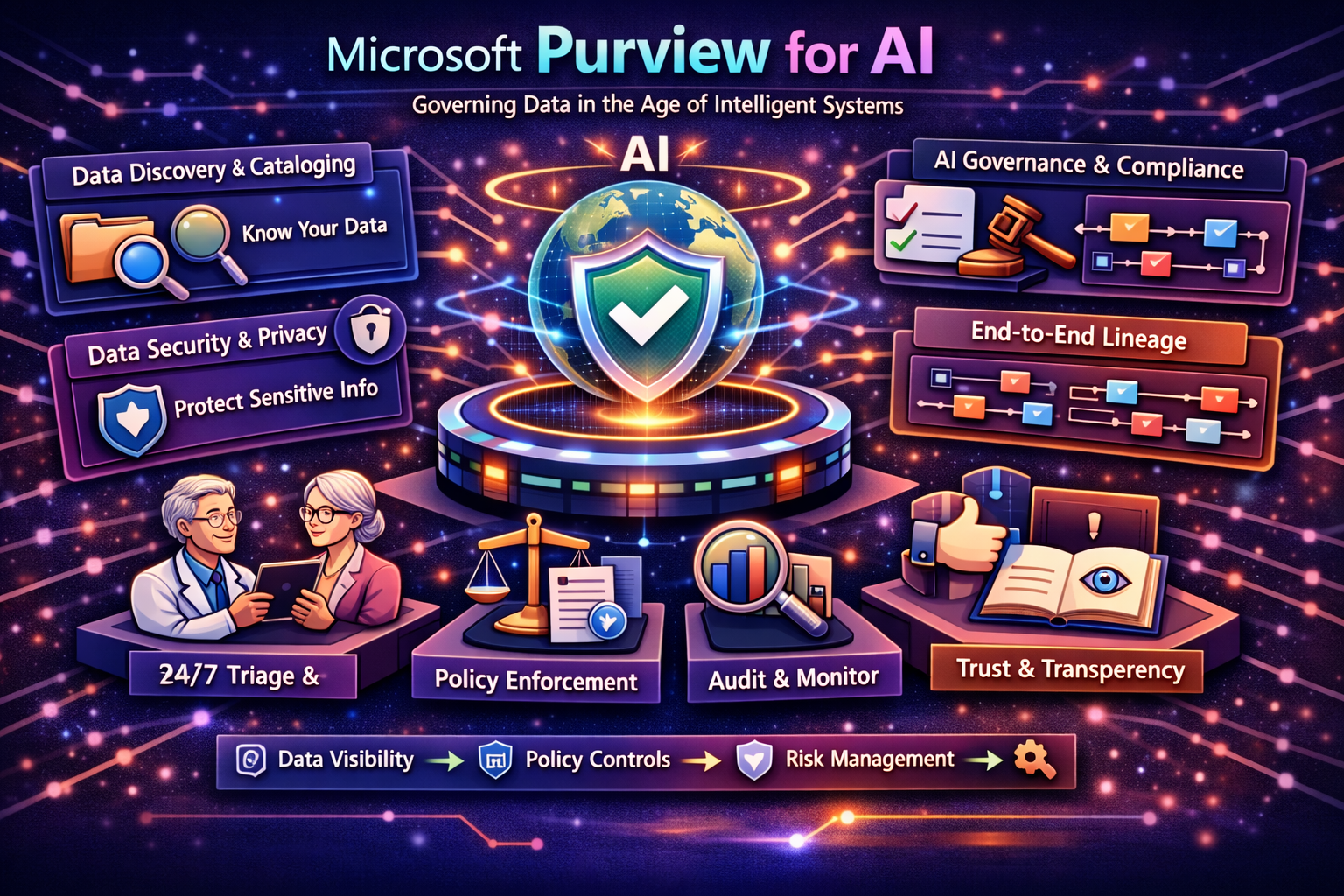
Understanding Microsoft Purview for AI
Microsoft Purview is Microsoft’s unified platform for data governance, data security, and compliance. In the context of AI, its importance has grown significantly because intelligent systems rely on large volumes of data that must be discovered, classified, protected, governed, and monitored throughout their lifecycle. Microsoft Purview for AI is therefore not a single isolated feature. It is the broader application of Purview capabilities to the governance and protection challenges introduced by copilots, agents, generative AI tools, analytics platforms, and AI-powered workflows.
This matters because AI increases both opportunity and risk. Organizations want to accelerate innovation with copilots, agents, and intelligent applications, but they also need to control oversharing, prevent data loss, maintain compliance, and understand how sensitive information is being used. Microsoft Purview helps address that challenge by providing a more unified and policy-driven approach to governing data in AI-enabled environments.
Why Data Governance Becomes More Critical in the AI Era
Traditional data governance was already important for analytics and enterprise reporting, but AI raises the stakes considerably. Modern AI systems can retrieve, summarize, transform, and act on information faster and at broader scale than traditional applications. If the underlying data is poorly governed, incorrectly classified, overshared, or inaccessible through the wrong controls, the risks can multiply quickly across the organization.
Microsoft Purview matters in this new landscape because it helps organizations understand where their data lives, who can access it, how it is labeled, how it flows, and how it interacts with AI systems. That visibility is essential for balancing AI innovation with enterprise trust, security, and regulatory obligations.
Core Capabilities of Microsoft Purview for AI
Microsoft Purview includes a broad set of capabilities that support data governance and protection across AI-driven environments.
-Data Governance: Helps organizations discover, map, catalog, and understand data across their estate so AI systems can be built on more trusted and visible information foundations.
-Data Security: Supports protection of sensitive information through capabilities such as information protection, data loss prevention, and risk-aware controls across the data lifecycle.
-Data Compliance: Provides compliance-oriented capabilities such as audit, eDiscovery, records management, data lifecycle management, and compliance monitoring for regulated environments.
-Unified Catalog and Data Map: Help create visibility into data sources, metadata, lineage, and business context so organizations can govern data more effectively in analytics and AI use cases.
-Data Security Posture Management for AI: Provides centralized visibility and control for AI usage, helping organizations identify and manage risks related to copilots, agents, and other AI applications.
-AI-Aware Risk Controls: Helps organizations implement governance and protection policies for Microsoft AI experiences, custom AI applications, and selected third-party AI usage scenarios.
-Integrated Security and Governance Model: Reduces fragmentation by allowing data governance, security, and compliance teams to work from a more coordinated platform.
From Data Governance to AI Governance
One of the most important shifts happening in the enterprise is the move from traditional data governance toward broader AI governance. In the past, many organizations focused mainly on reporting quality, metadata management, retention, and access control. Those concerns still matter, but AI introduces new questions. What data is being exposed to copilots? Which sensitive records are reachable by agents? How can organizations monitor the use of AI applications that interact with enterprise data? Where is oversharing happening, and what protections are in place?
Microsoft Purview helps answer these questions by extending governance into AI scenarios. It allows organizations to think not only about where data exists, but also about how that data is used, transformed, and potentially exposed by intelligent systems. This makes Purview a strategic part of AI governance rather than only a traditional compliance tool.
Data Security Posture Management for AI
A particularly important capability in Microsoft Purview for AI is Data Security Posture Management for AI. This provides a more centralized way to understand AI usage and secure data in AI applications. It is designed to help organizations identify where copilots, agents, and other AI apps may interact with sensitive information and where additional protections or policy changes may be required.
This is highly valuable because many organizations are adopting AI quickly across business units, often faster than governance processes can keep up. A posture management approach helps teams move from reactive control to proactive oversight, making it easier to understand AI exposure, detect emerging risk, and apply more informed governance decisions before issues become larger incidents.
Unified Catalog and the Foundation of Trusted AI Data
AI systems are only as trustworthy as the data foundations beneath them. Microsoft Purview supports this through governance capabilities such as Unified Catalog and Data Map, which help organizations build visibility into their data estate. These capabilities make it easier to understand where data resides, how it relates to business domains, how it moves, and which assets are reliable enough to support analytics and AI use cases.
This is especially important in the age of AI because responsible innovation depends on confidence in the data being used. If teams cannot find the right data, do not understand its lineage, or cannot distinguish between governed and ungoverned sources, AI initiatives become harder to trust and harder to scale. Purview helps reduce that uncertainty by making enterprise data more visible and more governable.
Protecting Sensitive Data Across AI Applications
One of the major challenges in AI adoption is the risk that sensitive information may be exposed, overshared, or used inappropriately through AI systems. This can happen in internal copilots, generative AI apps, external AI tools, agent-based workflows, and analytics environments. Microsoft Purview addresses this challenge by combining data discovery and governance with security controls such as information protection and data loss prevention.
This protection model is important because enterprises increasingly operate in mixed environments. Some AI systems are built inside Microsoft ecosystems, others are custom-developed, and some may involve third-party AI services. Purview helps organizations apply a more consistent protection strategy across these scenarios so governance does not stop at the edge of one platform.
Compliance and Regulatory Readiness in AI-Driven Environments
Compliance remains a major concern as intelligent systems become more common in business operations. Regulations, retention obligations, audit requirements, and data handling policies do not disappear when AI is introduced. In many cases, they become more complicated because AI can change how data is accessed, summarized, and used across workflows.
Microsoft Purview helps organizations respond to this reality by providing compliance-oriented capabilities such as audit, eDiscovery, records management, data lifecycle management, and compliance management. These capabilities help ensure that AI adoption can be aligned with broader legal, regulatory, and organizational obligations rather than operating outside them.
How Microsoft Purview Supports Copilots, Agents, and Generative AI
Microsoft Purview is especially relevant in environments where organizations are adopting copilots, AI agents, and generative AI applications. These systems often rely on broad access to enterprise content in order to be useful, but that same access creates risk if it is not governed carefully. Purview helps organizations understand and reduce those risks through visibility, policy enforcement, security controls, and AI-specific posture management.
This makes it an important platform for organizations that want to adopt AI responsibly. Instead of choosing between innovation and control, they can build a stronger governance model around AI usage so data remains protected while intelligent applications continue to deliver value.
How Purview Fits into the Microsoft AI and Data Ecosystem
Microsoft Purview becomes even more valuable when it is used as part of a broader Microsoft data and AI architecture. It serves as the governance, protection, and compliance layer that supports analytics platforms, AI systems, and data-driven applications across the enterprise.
-Microsoft Fabric: Benefits from Purview governance and security innovations that help organizations govern analytics and AI-ready data estates more confidently.
-Azure OpenAI Service: Can be governed more effectively when sensitive enterprise data and access policies are managed through Purview-aligned controls.
-Azure AI Search: Benefits from governed and discoverable data sources that improve retrieval quality and reduce exposure risk in grounded AI solutions.
-Microsoft 365 Copilot and Agents: Are supported by Purview capabilities that help organizations manage AI-related data risks and policy requirements.
-Azure Data Estates and Analytics Platforms: Gain stronger governance visibility through cataloging, mapping, classification, and policy-aligned protection.
-Microsoft Security and Compliance Stack: Works together with Purview to create a broader security, governance, and compliance posture for AI-driven business environments.
Architecture Considerations for AI Governance with Purview
A strong AI governance architecture requires more than one policy or one dashboard. Organizations should think carefully about where data is stored, how it is classified, who can access it, what AI systems can retrieve it, and what protections must remain in place as information moves through intelligent workflows. Microsoft Purview supports this by providing capabilities across governance, security, and compliance rather than limiting control to only one layer.
In many enterprise environments, Purview becomes the control plane for visibility and trust. Data is cataloged and understood, sensitive assets are labeled and protected, usage is monitored, and AI-related posture is reviewed across Microsoft and broader environments. This architecture helps organizations govern AI as part of the full data lifecycle instead of trying to manage it only after risk appears.
Best Practices for Adopting Microsoft Purview for AI
-Start with Visibility: Build a clear view of where sensitive data lives and how it is used before scaling AI broadly across the organization.
-Treat AI Governance as an Extension of Data Governance: Do not separate AI adoption from the existing governance and protection strategy.
-Use Data Security Posture Management for AI: Monitor copilots, agents, and AI applications proactively so risks can be addressed early.
-Strengthen Classification and Labeling: Ensure data is categorized and protected appropriately before it becomes widely accessible to intelligent systems.
-Align Security, Governance, and Compliance Teams: Use Purview’s unified approach to reduce silos and create more coordinated AI oversight.
-Review Policy Fit Continuously: Update governance controls as AI use cases evolve and new workflows, platforms, and risks emerge.
Common Challenges Organizations Should Address
One common challenge is assuming that AI governance can be added later once applications are already in production. In reality, weak visibility and poor data governance can create risks early in the adoption process, especially when copilots and agents interact with broad enterprise content. Purview is most effective when governance is built into the AI rollout strategy from the beginning.
Another challenge is organizational fragmentation. Data governance teams, security teams, compliance teams, and AI builders often work separately, even though their responsibilities increasingly overlap. Microsoft Purview helps reduce that fragmentation, but success still depends on aligning those teams around shared policies, shared visibility, and shared accountability for AI-era data governance.
The Strategic Value of Microsoft Purview for AI
Microsoft Purview delivers strategic value because it helps organizations govern data with confidence while adopting increasingly powerful intelligent systems. It reduces the gap between innovation and control by giving enterprises a way to discover, understand, protect, and manage data across the environments where AI now operates.
For leaders, this means AI governance becomes less reactive and more operational. Instead of treating data protection as a barrier to AI progress, Purview helps make governance part of the platform strategy that enables safer and more sustainable AI transformation.
The Future of Data Governance in the Age of Intelligent Systems
The future of AI governance will depend increasingly on unified visibility, stronger policy enforcement, better classification, AI-aware posture management, and tighter coordination between data, security, compliance, and AI teams. As copilots, agents, and generative systems become more embedded in daily work, the organizations that succeed will be the ones that can govern data as actively as they innovate with it.
Microsoft Purview is well positioned for that future because it already combines data governance, data security, and compliance capabilities in a platform increasingly oriented toward AI-era needs. As intelligent systems continue to expand, Purview will remain a critical part of how organizations protect trust while scaling AI.
Conclusion
Microsoft Purview for AI is helping organizations govern data in the age of intelligent systems by unifying governance, security, and compliance across the environments where AI now operates. With capabilities such as Unified Catalog, Data Map, information protection, data loss prevention, compliance controls, and Data Security Posture Management for AI, it provides a strong foundation for responsible AI adoption. For organizations seeking to innovate with copilots, agents, analytics platforms, and generative AI while maintaining trust and control, Microsoft Purview is an increasingly strategic part of the enterprise AI architecture.